The short version
| Made by | Claude Fable 5.2, prompted by Felix Rieseberg (Anthropic) |
|---|---|
| Shared | November 9, 2026, on X, the day Fable 5.2 launched |
| Instruction | One short prompt, no human feedback during the run (read the prompt) |
| Run time | About 8 hours (reported) |
| Tokens | About 445 million input, 2.7 million output, heavily cached (reported) |
| Cost | About $550 at API pricing (reported) |
| Assets | Models, textures and sounds made from scratch, generated in the browser |
| Later changes | About 2 hours of human-guided fixes to weapons, sound and gameplay |
All figures come from Felix Rieseberg's launch post and the note on the game's title screen. They are self-reported and rounded, and we present them as reported, not as measured facts.
How Saltline was made, step by step
1. A test, not a product
Felix framed Saltline as a test: he wanted to see the quality of Fable 5.2 with one-shot prompts and no human feedback. Earlier the same day he had already asked the model for a set of smaller games and kept the very first drafts. Saltline was the ambitious follow-up: an FPS meant to look like it could keep up with AAA, limited to one tiny level.
2. An eight-hour autonomous run
The prompt started a long agent session, not a single answer. For about eight hours the model wrote code, generated assets, ran the game, read the results and fixed what was wrong, over and over, with nobody steering it. Felix did not say which tool ran the session or which settings it used, only that his claude.mdinstruction file was empty.
3. Everything generated in code
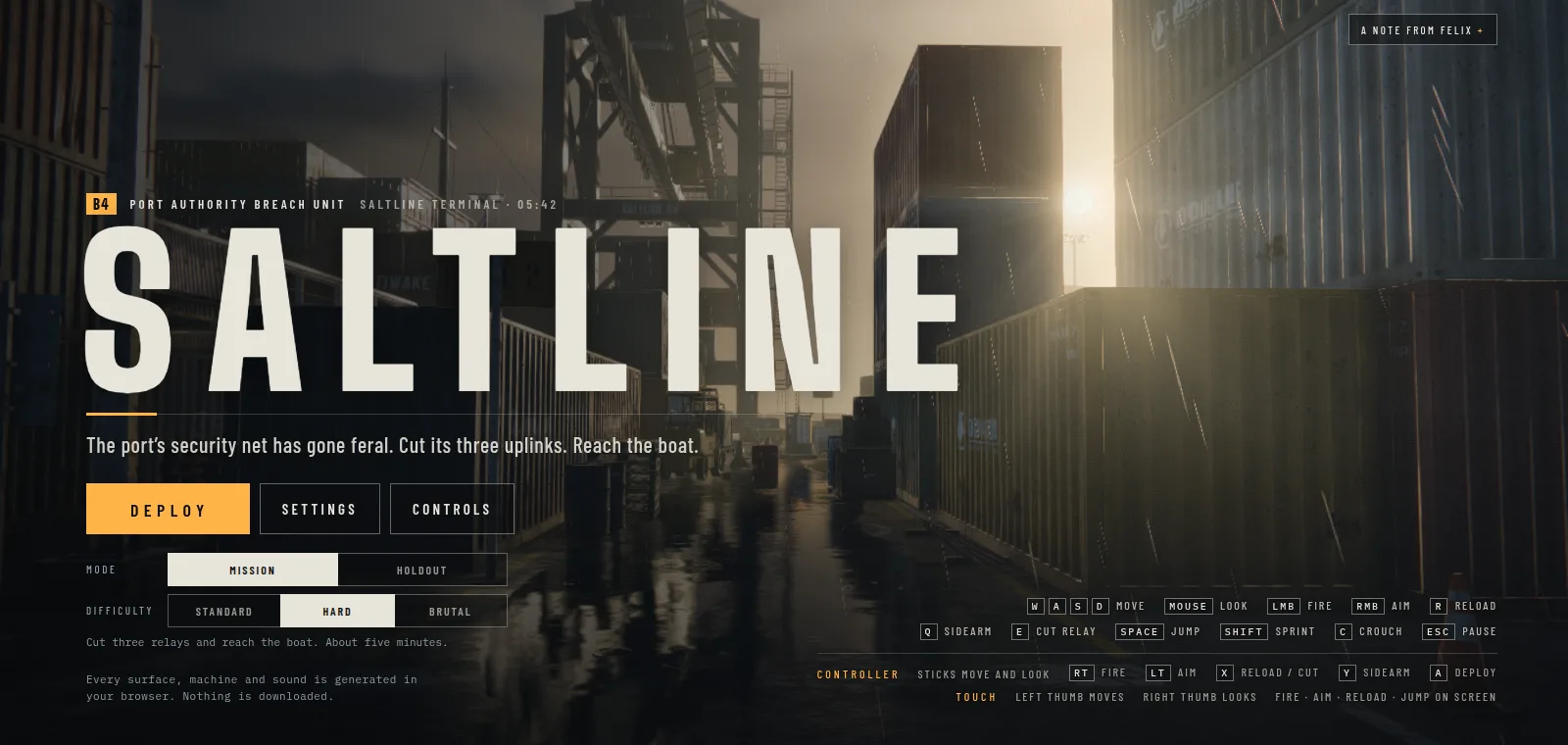
No art or audio files were supplied. The 3D models, the textures on containers and asphalt, the rain, the lighting and the sounds were all produced by the model. The title screen says it plainly: every surface, machine and sound is generated in your browser, and nothing is downloaded. That is also why the first load takes a while. Your browser is building the port before you can play it.
4. Published as a Claude artifact
The finished game was shared as a public Claude artifact, a page hosted on claude.ai that anyone can open without an account. The page carries a notice that its content is user-generated and unverified, and a Duplicate button that lets anyone copy it into their own Claude account.
5. Two more hours of polish
After the post went viral, Felix spent about two more hours improving the weapon models, sounds and some gameplay. The current version includes those changes. The original no-feedback version is still available from the note on the title screen, or directly here, so you can compare the two.
Reading the token numbers
The figure that surprises most people is the input: about 445 million tokens in, against about 2.7 million out. That is roughly 165 tokens read for every token written. The reason is how agents work. On every step the model re-reads its growing context: the instructions, the code so far, the output of the last test run. Over hundreds of steps in eight hours, the same text is read again and again.
That is where caching comes in. Text the model has already seen can be served from the prompt cache at a small fraction of the normal input price. Felix described the run as "heavily cached", and that is the only way 445 million input tokens fit into a bill of about $550. CellCog's cost breakdownworks through the list prices and estimates that the same run without any caching would have cost several thousand dollars.
A few simple ratios from the reported figures:
- About $69 per hour of autonomous work ($550 over 8 hours).
- About 340,000 output tokens per hour, which covers code, shaders and generated assets.
- About 56 million input tokens per hour, almost all of it re-read context.
Was it really "one prompt"?
Yes and no. One instruction started the run and no human stepped in during it, which is what Felix claimed. But the critics have a point: a run that reads 445 million tokens is a long autonomous process, not a one-shot answer, and someone pasting the same words into a chat window will not get Saltline back. The fair summary is one prompt, one long agent run, and two hours of human polish afterwards.
Other limits are worth keeping in mind. The game is a single short level, the enemies are machines rather than human soldiers, and some players hit stutter and freezes. None of that changes what the run shows: a model, left alone for a working day, produced a playable, good-looking shooter with every asset made in code.
Why it matters for browser games
Saltline arrived alongside a wave of games built with Fable 5.2: exploration games, sports games, a boss duel, a voxel copy of the Earth. Most take a similar route: a short prompt or design, a long agent run, and a game that runs in the browser with assets made in code. We keep a list on Fable 5.2 games, and if you want to try the process yourself, start with how to make a game with Claude.